Post a short description of a particularly compelling version of utopia from a text, film or other work of art. How does it align with More’s description?
Lois Lowry’s The Giver presents a thought-provoking exploration of utopia through the lens of a society that seeks perfection by eradicating all potential sources of discord and unhappiness. This society achieves what it perceives as utopia by suppressing emotions, memories, and individual differences, creating an environment of extreme stability and conformity. The narrative centers on Jonas, a young boy who is selected to inherit the position of Receiver of Memories, a role that exposes him to the hidden truths and the repressed history of his community.
While The Giver is fundamentally a dystopian novel, it engages with some of the utopian themes addressed by Thomas More in his seminal work, Utopia. More’s vision of utopia involves creating a balanced and just society where property is communal, and the welfare of each individual contributes to the welfare of the whole community. Similarly, the society in The Giver aims for a form of communal living where everyone follows prescribed roles and rules, purportedly for the collective good.
However, unlike More’s optimistic utopia, which suggests a holistic well-being achieved through rational social order and moral integrity, The Giver reveals the dark side of striving for societal perfection. The community’s approach involves sacrificing the richness of human experience by eliminating not just suffering but also the capacity for real joy, love, and deep emotional connections. The removal of these elements is seen as a necessary trade-off for what they believe is a harmonious existence.
Jonas’s journey as the Receiver of Memories brings him face-to-face with the costs of such a society. Through his eyes, we see the critical flaws in a utopian vision that requires absolute conformity and uniformity. His revelations challenge the notion that true utopia can be achieved through control and suppression, highlighting instead the importance of individuality, emotional depth, and moral choice.
The narrative starkly contrasts with More’s idea that a balanced society does not need to sacrifice individual freedoms for the greater good. Instead, it suggests that a genuinely harmonious utopia should embrace human complexities and frailties. The Giver thus serves as a cautionary tale about the potential perils of an overly sanitized society that seeks to engineer a flawless human condition, ultimately arguing for a version of utopia that acknowledges and integrates the full spectrum of human experiences.
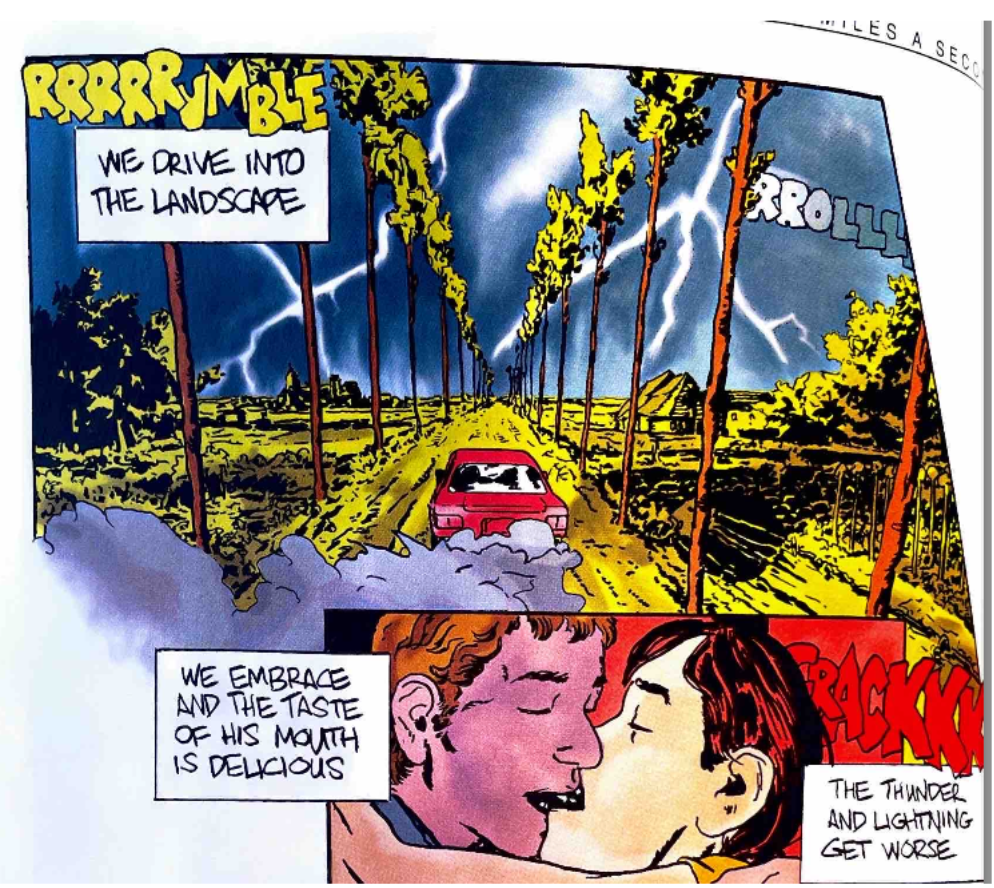
Make screenshots or somehow capture two images from 7 Miles a Second—one that you see as utopian and the other that you see as dystopian. (Maybe you even choose one image that could go either way!) Write one sentence to accompany each image that explains your choices
The graphic excerpt from David Wojnarowicz’s “7 Miles a Second” conveys a dichotomy of themes through its juxtaposition of imagery and text. The first panel’s depiction, with its stark, stormy backdrop and the phrase “RRRRRUMBLE,” suggests a world on the brink of upheaval, echoing dystopian motifs of instability and the relentless passage of industrial time. The clouds roiling above a car fleeing into the distance evoke a sense of escape from a world teetering on the edge of turmoil.
In contrast, the bottom panel introduces a starkly intimate moment between two characters, their embrace and the description of a kiss, symbolizing a pocket of serenity and human connection amidst chaos. The phrase “the taste of his mouth is delicious” stands as a testament to finding beauty and pleasure in small, personal experiences, even when the larger world seems grim. This moment of affection is underscored by a “CRACK” that serves as a reminder of the persistent storm, suggesting that while there can be moments of peace, the threat of dystopian reality is never far away.
The imagery and its interplay with the text invoke a layered interpretation. The serene drive into a vibrant landscape can symbolize hope and the enduring human spirit, while the darkening sky and the oncoming storm may represent the persistent challenges and threats of a dystopian society. This duality mirrors the subjective nature of art and its reflection of human experience: the capability to find or recall beauty and hope in moments of intimacy and love, even when faced with the ominous and the unknown. It is a visual and textual representation of the human condition, resonating with the complexity of seeking utopia within a dystopian reality.
“7 Miles a Second” thus offers a narrative that is not just about the literal journey through a landscape but also about the emotional and psychological journey through life’s challenges. The characters’ embrace, juxtaposed with the storm, serves as a metaphor for resilience and the human capacity to find connection and meaning in the face of adversity.
Susan Foster’s writing offers choreography as a strategy for organizing protest movements. Identify one issue that means something to you. How might you choreograph bodies to intervene in and/or bring attention to that issue? For your moodle post, offer a short description of your choreographic vision for an embodied intervention.
“Rising Tide,” this performance would serve as a poignant visual metaphor designed to bring the urgent issue of climate change directly to a public audience in an immersive and thought-provoking manner. The performance would take place in a highly frequented urban square, strategically chosen to maximize visibility and engagement from a diverse cross-section of the public. Dancers, adorned in flowing fabrics of blue and green, would begin the performance lying flat on the ground in scattered, still forms around the square. This initial state symbolizes the world’s current stagnation and neglect towards escalating climate issues.
As the performance progresses, the dancers would slowly rise, gradually at first, to mimic the initially unnoticed rise in sea levels. This slow, almost imperceptible ascent reflects how climate change often goes unnoticed until its effects are dire. The choreography would involve synchronized, wave-like movements that gradually become more pronounced and urgent, symbolizing the increasing speed at which climate change is affecting our environment.
The dancers’ encroachment into the audience’s space serves as a direct metaphor for the displacement caused by rising sea levels, with the ‘water’ moving closer to ‘land,’ thereby shrinking the space where the audience stands. This interaction not only breaks the fourth wall but also places the audience directly within the ‘disaster,’ making the experience personal and immediate. The crescendo of the performance would feature intense music with a rising tempo and dancers moving rapidly and chaotically, symbolizing the chaotic destruction that unchecked climate change could cause.
The final formation, where dancers collectively form an image of Earth engulfed by rising seas, serves as a powerful visual statement of our planet’s potential future.
To further enhance the impact, the conclusion of the performance could be followed by a moment of silence, allowing the audience to reflect on the experience, followed by an invitation to interact with informational booths or activists ready to discuss practical steps and solutions. This would link the emotional and aesthetic impact of the performance with actionable outcomes, encouraging immediate personal engagement and long-term commitment to environmental advocacy.
